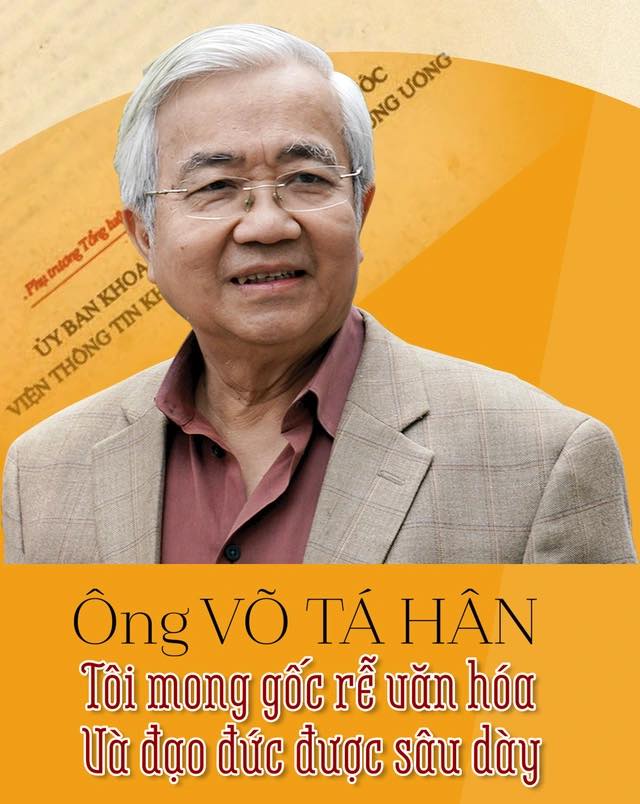
VO TA HAN A BEACON OF LIGHT FOR VIETNAM WHO SENT OVER A MILLION BOOKS HOME Presented by NguyEn XuAn Xanh
“Among the many worlds which man did not receive as a gift of nature, but which he created himself out of his own mind, the world of books is the greatest.” —Hermann Hesse, author of Siddhartha
Foreword. The newly released issue of Tuoi Tre Weekend magazine, dated April 30, 2023, features a 4-page interview with Vo Ta Han, with his photo on the cover. An issue released on a “historic day” “honors” an overseas Vietnamese who, over the past three decades, has successfully sent over a million foreign-language books to Vietnam to serve study and research.
Is this a coincidence? But even if it is, it seems to signal that Vietnam’s next development phase will no longer be determined by pure politics, as in past decades, but by knowledge.
To achieve this, the country must have abundant knowledge, knowledge infrastructure, book collections, libraries, reading rooms, journals, seminars, laboratories, conferences, scientific institutions, a passion for learning, and it needs intellectuals, scientists, researchers, and technocrats to shoulder this new mission.
This issue will “go down in history” as signaling a necessary and inevitable turning point, if we want a prosperous country, a “rich people, strong nation, and a just, democratic, and civilized society.”
Economic competition is the competition of innovative ideas. Without books to learn from, or without the will to learn and exchange with the world, how can creative ideas emerge? Enough of the inertia of history, enough of wasting golden time. The wheel of history is turning right beside us, ready to crush ignorance and error.
The widespread “fear of books” mentality and lack of responsibility, which once caused the book donor immense difficulties, has now turned into a warm and grateful welcome. Let knowledge and intellectuals have a voice.
 |
| A view of the books imported by Mr. Vo Ta Han |
History, please turn the page and close this arduous chapter, full of thorns and unnecessary suffering, which has afflicted a delta that should have been peaceful for the past few decades. “Those heroic pages of history will eventually pass, fading in memory,” as Abraham Lincoln said. New generations must build a new memory, a new pride, using sober reason as the substance of the future—a future for which books are the tools of enlightenment and guidance.
A million books also carry the meaning that Vo Ta Han is helping to heal the past psychological trauma from when countless books were unjustly destroyed in the flames of fanaticism, hatred, error, and ignorance of war. Knowledge and learning are beginning to revive, bringing great hope. Science once disappeared in the Occident (the “Land of the Evening”), but after more than a thousand years, it was revived along with the medieval university. We have only had 48 years; it is still “too early to be weary,” isn’t it?
Look at the perseverance of Vo Ta Han, the bringer of light. I cannot help but quote the following words from Professor Phan Van Truong, upon reading the news about Vo Ta Han’s massive book donation program this past April 10th: “There are truly no words to describe the love for his country and the love for science that Mr. Han has tirelessly demonstrated.” Yes, one must have such a deep and persistent love for the country to make such “miraculous” contributions. That love, in time, will achieve victory for the country.
I invite you to read Vo Ta Han’s very interesting interview in the aforementioned, still-hot-off-the-press issue. I will publish its contents in the middle of next week. But having a beautiful, original copy of the magazine in hand remains a wonderful memento of a man who truly deserves our admiration, doesn’t it?

Before concluding, please take a look at the photo (above) of the Duchess Anna Amalia Library in Weimar, which was once the gathering place for the German literary world of the 18th century.
The great poet Wolfgang von Goethe was entrusted by Anna Amalia’s son with the task of managing and directing it from 1797, and he held this position until his death in 1832.
 |
| Leiden University Library, Netherlands, in the 17th century. The books were chained and could only be read on-site. |
 |
| Göttingen University Library, mid-19th century painting. |
A Few “Personal Reflections” Upon Learning Mr. Vo Ta Han Had Sent Books to Vietnam Early
I was extremely surprised to learn that Mr. Han had been sending books back since 1988! At that time, I had just arrived back in the city, still finding my footing. I brought back a library and worried to death about protecting it, terrified of termites! Termites are a dreadful enemy of books. My housing situation was unsettled then, so I had to move the entire library—packed in cardboard boxes—from one place to another; from a warehouse in the old Japanese Embassy to a friend’s house. Each time I moved, I had to sprinkle termite poison all over the storage room.
I was also very lucky to have friends who wholeheartedly supported me, until I could finally settle properly into my house in District 7. When my house renovation was finished, one night, I was able to set up all my Lundia pine bookshelves and arrange the books on them just as they had been in Germany. When the work was done, I breathed a sigh of relief. Here it was, my world of books still beside me like an old confidant. And I slept the first night on a breezy pine plank bed, right on Christmas Eve, while the iron gates were still waiting for glass panes to be installed. I was so happy, and I put an end to a “wandering” part of my life, ending the scene I had captured in these few verses from my final year before returning home:
Today, no door, no house No homeland, and no friends Half a life spent wandering Grey autumn clouds, cold winter wind Lights, cars, streets, markets still bustling But why does my heart feel no stir
With the persistence of the tireless “merchant of light” for over thirty years, books have been warmly welcomed, serving education and research, and book culture has spread. Mr. Han’s shipments of books have proven that not only do we need to open the door to foreign investment—a field where Mr. Han also made great contributions—but it is also imperative to open the door for books, to invest in books, in order to build people, to build internal strength.
How joyous! A “new normal” for book culture has been established. If we want to “Learn, learn more, learn forever,” we must “Have books, have more books, have books forever.” To “plant people for a hundred years” (a famous Vietnamese saying on education), we need many, many books—good books, useful books, constructive books, books that build vision. How farsighted Mr. Han has been!
The world’s libraries are symbols of investment in people and culture. They are the knowledge infrastructure for a nation, the indispensable heart of every university. The Japanese managed to acquire Adam Smith’s personal library for the Faculty of Economics at the University of Tokyo! How they treasure books, treasure knowledge, and treasure scholarship!
(10/11/2024)
Best regards,
Nguyen Xuan Xanh
28-4-2023

Below is the interview published in the Tuoi Tre Weekend newspaper:
Mr. Vo Ta Han: “I wish for the roots of culture and ethics to grow deep”
Interview by: CẦM PHAN
TTCT- In the language of the 18th-century Enlightenment, Mr. Vo Ta Han is one who gives light to Vietnam. Mr. Han is perhaps the person who has donated the most books to a single country.
Within him are three distinct, successful individuals: An international banker who worked for major corporations; the man who organized a massive book donation program, sending over 1 million volumes to Vietnam; and a talented classical guitarist with hundreds of compositions, especially music set to Buddhist sutras.
Dr. Nguyễn Xuân Xanh remarked about him: “In the language of the 18th-century Enlightenment, Mr. Han is one who gives light to Vietnam. Books are light, helping people to enlighten their minds, broaden their horizons, and see the world. Mr. Han is perhaps the person who has donated the most books to a single country.”
Tuoi Tre Weekend spoke with him this April.

I AM JUST A LUCKY PERSON
Let’s return to a milestone: the 10-page proposal titled “Singapore – Vietnam / A Proposed Strategy For Business Development,” which you completed on February 6, 1992, and submitted to Mr. Lee Kuan Yew, opening a chapter of active economic and trade relations between the two countries.
– That was the result of my many years living and working in Singapore, directly managing and advising organizations and businesses there, and also serving as president of the Canadian Business Association in Singapore (later the Canadian Chamber of Commerce)… I was invited to join a 25-person advisory group for the Singaporean government on the “Singapore 2000” model, before the country entered the new millennium.
At that time, although Singapore still maintained its embargo policy against Vietnam, I was asked to write a strategic advisory report on relations with Vietnam. In the proposal, I pointed out 10 benefits for Singapore in resuming relations with Vietnam, which sectors both sides could cooperate in, and particularly emphasized that if Singapore wanted to invest in Vietnam, it had to act faster than other countries.
During this time, I also organized many seminars to introduce cooperation opportunities with Vietnam in trade, banking, real estate, IT… helping to bring Vietnam to Singapore when businessmen from the island nation were not yet allowed to set foot in Vietnam.
Among the companies I brought to Vietnam, I was most passionate about Unilever because I had closely observed how they operated in other countries and saw their sustainable approach, their focus on training and developing human resources, and their use of local raw materials and market development.
The proposal concluded with 10 specific recommendations, such as encouraging connections between high-level state agencies of both sides to exchange and share management experiences from the Singaporean model, and granting scholarships for Vietnamese students to study in Singapore. Generally, all of them were implemented!
Before that, in late 1991, you assisted the Singapore Trade Development Board’s delegation on its first official visit to Vietnam. What was special about that visit in that context?
Actually, my first visit back to Vietnam was in early 1988, when I brought a Canadian business delegation, but that time it only included a few companies. The Singapore Trade Development Board was an official state delegation from Singapore, including many private corporations and companies from the government’s Temasek investment fund.
Before the trip, the Singaporean side expressed concern because relations between the two governments were not very warm. However, the visit to Vietnam was considered by the delegation to be a success beyond expectations. Everyone highly valued it and looked forward to the normalization of relations between the two countries to get straight to work.
Prior to that, I had also brought Singapore Airlines to Gia Lam in 1989 to sign a memorandum of understanding to prepare for the Vietnam-Singapore route, and I helped corporations like Keppel and Singapore Land to draft real estate investment plans.
A few months after the visit in late 1991, Prime Minister Vo Van Kiet traveled to Singapore in April 1992 to sign a bilateral investment treaty. In 1994, Vietnam Airlines began flying to Singapore, and by 1996, the first Vietnam-Singapore Industrial Park (VSIP) was established.
At that time, what path did you envision for Vietnam and what were your hopes for the homeland? From then until now, do you see Vietnam on the path you had hoped for, and what has it achieved or missed?
Entering the Đổi Mới (Renewal) period, the first priority was economic development. Among Southeast Asian countries, Singapore, though small, sparsely populated, and lacking natural resources, had skillfully absorbed Western civilization, becoming remarkably advanced in a short time.
As early as the meeting with Mr. Phan Van Khai’s delegation visiting Singapore in 1988, I suggested Vietnam should choose Singapore as its economic development model. Of course, it couldn’t be applied mechanically, but the results from Singapore’s economic “test tube” could be replicated a hundred times over for Vietnam, as long as it was adapted appropriately, especially paying attention to cultural characteristics and the nature of the people.
From the days when the two countries “looked at each other as strangers” to Singapore becoming the largest investor in Vietnam for the past 3 years, it has been a long and correct journey in the cooperation between the two nations, just as hoped. However, there will still be many challenges to overcome in the next phase, especially in the current uncertain global economic context.
As an advisor to the Vietnamese state on innovation, covering many fields, notably advising on selecting and building economic models, helping localities… In which areas were your recommendations most effectively heard and applied?
In 1973, I wrote my master’s thesis at the Massachusetts Institute of Technology (MIT) on the topic “Export Processing Zones and Post-War Vietnam.” After my first visit to Vietnam in 1988, I summarized and published the thesis as a book. Early the following year, the book was translated by the State Committee for Science and Technology into a document within the “Foreign Economics” general report.
The main idea of the thesis was that after the war ended, the two troubling issues for Vietnam would be creating jobs for the people and finding sources of foreign currency for the country. As we were just beginning to transition from a command economy to a market economy, the export processing zone (EPZ) was the appropriate model.
During the Singapore Trade Development Board’s trip in 1991, before leaving Hanoi, the CEO of the Singapore Petroleum Company and I were asked for our opinions on Vietnam’s plan to build an oil refinery. I simply advised that at that moment, they should hold off on building a refinery and instead send crude oil to Singapore for processing. The immediate need was to build the North-South highway, creating a backbone for economic development and trade.
There were other suggestions, such as not developing all 55 provinces and cities simultaneously, but concentrating capabilities on 5 key points: Ho Chi Minh City, Hanoi, Da Nang, Hai Phong, and Can Tho. Afterward, these “locomotives” themselves would directly help other provinces develop more effectively.
Further, to help quickly develop the “carrying pole” provinces of the Central region, the State could grant tax exemptions to companies established in that area.
For Ho Chi Minh City, I suggested launching a “Keep the City Clean and Beautiful” program with Saigon Tourist. I suggested preserving the center of Saigon as an “old city” capable of attracting international tourists in the future and building a completely new urban area in Thu Thiem. HCMC would eventually expand with economic development, so instead of expanding Tan Son Nhat, the airport should be moved far from the city.
For foreign investment projects where the domestic partner needed to contribute capital, I suggested applying a 70/30 model, where the 30% domestic contribution would be calculated from prepaid land rent over many years…
Those were just a few suggestions from someone living abroad, with an incomplete understanding of local advantages (địa lợi). Of course, some opinions seemed “utopian” and couldn’t be, or weren’t, applied at the time.
You are an expert in economics and finance, having led very large corporations and organizations in banking, real estate, business administration, and education. What are the most important things such a career has brought you?
Oh, I was just an employee for large corporations, lucky enough to hold those positions. It’s not as if I were a founder who created jobs for countless people; that would be something to be proud of. During my time working with domestic partners, I met brilliant and talented people who just unfortunately lacked the opportunity to showcase their talents. I am simply a person who was much luckier than many others!
You also write practical, accessible, and easy-to-understand articles analyzing domestic financial management, business administration, guiding on how to get loans, how to negotiate contracts, business customs abroad… What motivates you to write?
In wartime, the country needs soldiers, but in peacetime, the “warriors” are the “businesspeople” (doanh nhân), and the battlefield is the marketplace. I advocated for writing practical, concise, and easy-to-understand articles precisely to share knowledge and experience to help this class of businesspeople when they were just rolling up their sleeves to enter the market, full of enthusiasm but lacking experience.
Small and medium enterprises (SMEs) are the backbone of an economy. It is from the experience of managing, operating, and steering these small boats that Vietnamese entrepreneurs will rise up to build powerful corporations, enriching themselves and the country! It’s as simple as that!
You have witnessed many global and regional economic crises. Now, another crisis period is unfolding, with businesspeople facing market and even policy uncertainties. What advice do you have for Vietnamese business owners today?
During my time working in Singapore, I went through 3 economic crises that made the “Singaporean boat” stagger, and I wrote a lot to share the experience of rescuing the companies I was directly involved with. However, now that I am retired, I no longer follow and grasp the current situation, so it is difficult to offer suitable recommendations for domestic entrepreneurs.
Furthermore, compared to 30 years ago, we have now trained many brilliant economic and financial experts and seasoned entrepreneurs who understand the domestic situation. They are the ones who can offer the most practical advice.
“Everything I do stems from the desire to see the Vietnamese people become ever more enlightened, to step out into the world with their heads held high, stronger, so that no one can bully us. Especially when we are next to a neighbor that is so strong and… not so friendly!”
— Võ Tá Hân
SUSTAINABLE DEVELOPMENT MUST RELY ON CULTURE
When discussing business cooperation with a country, you emphasize paying attention to that country’s culture and specific governance. Why do you stress the cultural aspect?
Developing a country isn’t just about the sole goal of per capita income. What good is it if the country produces a young generation that only admires foreign things, prefers to speak foreign languages, dreams of living abroad, and turns its back on its own people and country? Culture, therefore, is the very element that helps young people stay connected to their homeland.
In the final years of his life, the founding father of Singapore, Mr. Lee Kuan Yew, expressed regret that he had pushed for economic development too quickly, causing young Singaporeans to seem to l_ose their roots, not even knowing the meaning of the two words “motherland.”
We Vietnamese have a cultural tradition from thousands of years, deep and cohesive; that is a great advantage. Programs like the ‘Green Summer’ (Mùa hè xanh) have also helped the young generation connect with their homeland so that later, no matter where they go, they will still look towards their motherland.
The overseas Vietnamese community is also growing. Every Vietnamese person who leaves the homeland carries with them an image of Vietnam at the moment they left—some see it as a triangle, some a circle, others a square—leading to distorted and rigid views of the country.
Visits back to the homeland during holidays and festivals, and programs promoting Vietnamese culture, have helped overseas Vietnamese (kiều bào) continuously update their understanding of the situation to have a common view of the country and draw closer together. Those cultural connections are especially important for the diaspora, as they will be Vietnam’s extended arms.
 |
| Vo Ta Han’s master’s thesis at the Massachusetts Institute of Technology (MIT), titled “Export Processing Zones and Post-War Vietnam”, 1973.. |
30 years of development have brought the country to a higher level. We have moved from the economic sphere to cultural development, and now, I think it is time we should focus on promoting ethics. In business, the “secret to getting rich” can be summarized in 8 words: “Buy cheap – Sell high – Pay slow – Collect fast!” However, buying cheap, harmful things to sell for a large profit cannot be called success; it is an unethical act.
Entrepreneurs should not wait until they are successful to think about “business ethics.” The cultivation of ethics and culture must begin early, starting with children. The lessons of nhân, nghĩa, lễ, trí, tín (humanity, righteousness, propriety, wisdom, and trustworthiness) from childhood leave a deep impression on everyone’s mind and behavior until their hair turns gray.
When you founded VN2020 – a “playground” for young Vietnamese intellectuals and professionals in Singapore in 2007, you hoped this force would become an “internal economic force” for domestic companies later on. Has this expectation been realized since then?
The VN2020 program grew very strongly for about a decade when Singapore granted many university scholarships to attract Vietnamese talent. However, the program later faced opposition from the local populace, who argued that the state was favoring foreign talent too much, harming the job opportunities of Singaporeans. As a result, the number of scholarships for Vietnamese students was significantly reduced, and the VN2020 program subsequently ended.
Some VN2020 members who stayed to work in Singapore transitioned into the Vietnam Chamber of Commerce in Singapore, which is still active today.
I am very happy to see former VN2020 members who have become successful, returned to the country to hold important positions, and are making a good impact in their professional fields. No matter where they are in the world, they still feel a deep connection and desire to help their country in one way or another.
I AM NOT AFRAID TO BE A “KNOWLEDGE BEGGAR”
What motivated you to put 10 books in your suitcase to bring back to Vietnam during the embargo years, thereby starting an unprecedented book donation program for Vietnam? And how did the journey of bringing books to Vietnam continue after that?
When I first returned to Vietnam in 1988, coming from the prosperous country of Singapore to Saigon—which was just over an hour’s flight away but was then quiet and bare—I was truly stunned. Walking around downtown Saigon and visiting a few bookstores, I was shocked to see how poor the selection of books was.
On the flight leaving Vietnam at that time, I couldn’t hold back my tears. For a long time after, I kept thinking about what I could do to help the country. If I had gone to Mr. Lee Kuan Yew at that time to ask for Singapore’s help, people probably would have called me crazy. In the end, only we can save ourselves.
So, the idea of soliciting books for Vietnam came to me. Starting with one letter asking for books to send to the Hanoi Institute of Economics and the Saigon Institute of Economics, I duplicated that letter and sent it to 100 addresses, from MIT, Harvard, the World Bank, to major publishers.
I received the first 1,500 books, and from there I got acquainted with the publisher Simon & Schuster/Prentice Hall, gradually managing to buy books at low prices, tens of thousands of volumes at a time, sending them back home by the container.
Many years later, when I contacted a close friend who was the director of Irwin Publishing in New York, I was able to buy nearly half a million more books and transferred them in 40 large containers to the International University (in HCMC) for distribution to other universities.
With World Scientific Publishing, because of our close relationship, they have been donating books to me for free for over 20 years; I only pay for shipping. That has amounted to over ten containers.
From other places like Singapore Polytechnic, the Singapore Institute of Management, McGraw-Hill, PW Medical… I also solicited another few tens of thousands of volumes. I currently have over 30,000 more books from World Scientific that I plan to bring back this coming May.
After finding the books, the next step was how to get them to Vietnam safely and inexpensively. Importing books is no different from importing any foreign goods; it must pass through many “gates,” from applying for a censorship permit from the Department of Culture, to getting a tax-exemption permit for non-refundable aid from the Department of Finance, to handling customs declarations at the port… So, when the books safely reached the right destination as intended, my heart always filled with an indescribable joy.
I am now moving towards soliciting e-books. The first gift was 500 e-books donated by World Scientific to the Ho Chi Minh City University of Technology (Bách khoa) library early this April. I hope that in the future, we will have a publisher that can publish scientific books, starting with mathematics, to be disseminated globally in English.
When selecting books to bring home with the aim of helping the country develop, I only chose science and technology books.
What kinds of books do you usually read? Do you have a book that you particularly love?
The types of books I enjoy change depending on the time. Back in high school, I often read popular science, history, and biographies of great figures, especially the books by Mr. Nguyễn Hiến Lê. After going abroad, I enjoyed reading scientific research and philosophy books.
From before retirement until now, I have been fortunate to help my friend Hoang Phong Nguyễn Đức Tiến in Paris edit all his articles on Buddhism, translated from English or French. The author Hoang Phong has published over 30 Buddhist books in the last 20 years.
In addition, I also read many books about music, gathering many materials to write textbooks on this subject.

MUSIC AND BUDDHISM
You have composed over 800 songs, set many Buddhist scriptures to music, and released dozens of CDs. What is the significance of music in general, and Buddhist music in particular, to you?
I was born into a staunch Buddhist family. My paternal grandfather, from his time as Tuần vũ (Governor) of Kon Tum to Tổng đốc (Viceroy) of Quảng Ngãi, established pagodas wherever he went. I observed that Christianity values music highly, whereas Buddhism does not pay much attention to it, so I endeavored to compose Buddhist music pieces.
When setting sutras like the Amitabha or Universal Gate Sutras to music, I did it first for myself to understand the meaning of the scriptures, and then to disseminate the Buddha’s teachings to the masses. To date, I have set 9 Buddhist sutras to music, and during the Covid pandemic, the Sutra of the Medicine Buddha Cantata (Trường ca Kinh Dược sư) was listened to by many people.
I hope there will be Buddhist choirs, with the participation of youth, bringing music into the pagodas to sing compassionate songs, promoting pure love for family and homeland. I believe that is a good way to teach children, conveying lessons about love, family cohesion, and ethics in society.
Coming from the Saigon National School of Music, I have passionately supported the classical guitar movement in Vietnam for the past three decades and am very happy to see the guitar community in Vietnam growing stronger. In particular, Thu Le becoming a world-famous female guitarist is a pride for Vietnam in general!
I do not have the talent for writing poetry and lyrics, so I chose the path of setting poets’ works to music. My greatest fortune was that the piece Rất Huế (Very Hue) in my debut CD caught the eye of the late musician Pham Duy, who made an immortal comment: “Vo Ta Han’s music in this collection is truly wonderful!” Since then, not many people have known me as an international banker; they just call me a “musician.” At first, I felt a bit embarrassed, but well… I accepted it!
In your opinion, what role will Buddhism, Buddhist music, and Buddhist culture play, and to what extent will they influence the future of Vietnam?
We don’t need to look far; just look at Japanese Buddhism to see how its cultural influence and the power of meditation have brought a profound and stable spiritual foundation to the Land of the Rising Sun. Vietnam’s leadership also seems aware of this strength, aiming to guide the country toward a sustainable and pure spiritual and cultural foundation.
Do you still meditate every day?
I was fortunate to learn yoga and meditation from my father starting at age 12, and later studied meditation further with a Great Master in Singapore. I still meditate every day. My father, under the pen name Kim Hoàng Sơn, was also the founder of the Radiesthesia school (Cảm xạ học) in Vietnam in the 1960s.
If you ask where I get the strength to do so much in life, first, I must thank many teachers, from my father to the teachers in school, in life, and in books, especially Mr. Nguyễn Hiến Lê and Mr. Nguyễn Duy Cần. However, the main inner strength still comes from meditation. If we do not keep our minds stable, it is difficult to persevere and calmly navigate the storms of life.
Thank you for this conversation.